How hills and gradients affect electric scooter range
Climbing raises the rider and scooter against gravity, so it requires energy in addition to rolling and aerodynamic losses. Steeper grades, higher total mass and lower speed under load can also increase current and heat.
The descent does not cancel the climb. Regenerative braking recovers only part of the energy and may be limited by battery charge, speed, grip and controller design.
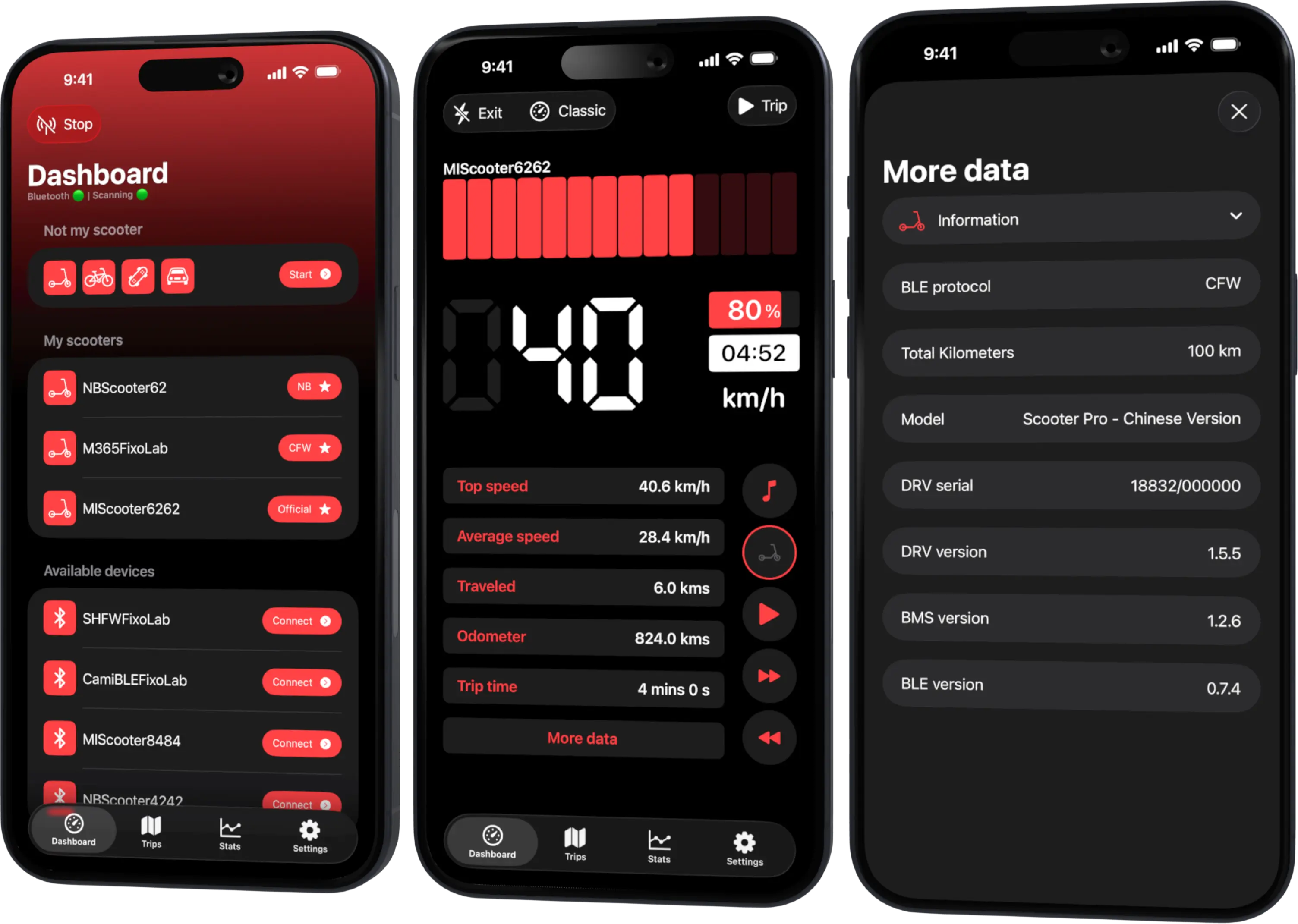
Your Xiaomi and Ninebot scooter dashboard
Monitor speed, battery, mileage, temperature and routes in real time, with support for official and custom firmware
Available on Android, iPhone, iPad and Mac, with Wear OS support and iCloud sync on Apple devices
Grade is not the same as angle
Road grade is usually rise divided by horizontal distance, expressed as a percentage. A 10% grade is not a 10-degree slope. Map elevation is also noisy over short distances, so do not treat every small spike as a real ramp.
Use official route information or a consistent map source and focus on sustained climbs.
Why mass matters more uphill
Moving more total mass upward requires more energy. Rider, cargo and scooter all count. A route that is comfortable for one load may exceed the documented grade or payload capability for another.
Respect the manufacturer’s maximum load and climbing guidance. Do not use telemetry as permission to exceed them.
Motor and battery behavior
On a long climb, the scooter may slow, draw more current or increase temperature. Protective firmware may reduce power. If a warning appears or performance changes abruptly, stop safely and follow the manual rather than repeatedly forcing the same hill.
Pushing at walking speed may be safer than holding full throttle below an efficient operating speed, but follow the exact model guidance.
Compare routes in Scooter Tools
Record distance, duration, speed, battery change and available temperature context. Compare:
- the same climb on similar days;
- outward and return directions;
- a flatter alternative of similar distance;
- consistent riding mode and payload.
Do not compare only kilometer totals. A shorter steep route may consume more than a longer flat one.
Descending safely
Do not descend faster in an attempt to maximize regeneration. Speed, braking and tire grip limits still apply. Start a long descent with enough battery headroom for the vehicle’s approved behavior, and expect regeneration to weaken when the pack cannot accept more energy.
Mechanical brakes must remain serviceable throughout the descent. Repeated braking can produce heat; use the technique prescribed by the manufacturer and stop safely if response changes.
Plan with a reserve
A route planner cannot perfectly predict traffic, wind or battery temperature. Keep extra charge for the largest climb, especially when it occurs on the return journey. In cold weather, combine the hill penalty with the seasonal reduction in usable battery.
For a general method, read how to estimate real-world range.
Frequently asked questions
Will a downhill return all the uphill battery?
No. Regeneration has conversion losses and operational limits.
Is a short steep route always more efficient?
No. Its climbing load can outweigh the shorter distance.
Can phone elevation be inaccurate?
Yes. GPS and map elevation can be noisy, especially over short segments.
Why does the scooter slow on a hill?
The required torque may approach model limits, while voltage, temperature and protective controls also affect available power.
Your Xiaomi and Ninebot scooter dashboard
Monitor speed, battery, mileage, temperature and routes in real time, with support for official and custom firmware
Available on Android, iPhone, iPad and Mac, with Wear OS support and iCloud sync on Apple devices
| FixoLab
How to estimate real-world electric scooter range
Estimate usable electric scooter range from repeatable trips, battery change and route conditions instead of relying on one advertised maximum.
| FixoLab
Reading Battery, Range, Temperature and Mileage in Scooter Tools
How Scooter Tools reads battery percentage, estimated range, temperature and mileage directly from your scooter's BMS over Bluetooth and shows them on your live dashboard.
| FixoLab
Eco, Drive and Sport modes on electric scooters explained
Compare electric scooter riding modes by acceleration, speed, range and traction, and use trip data to choose a mode for the route rather than the label.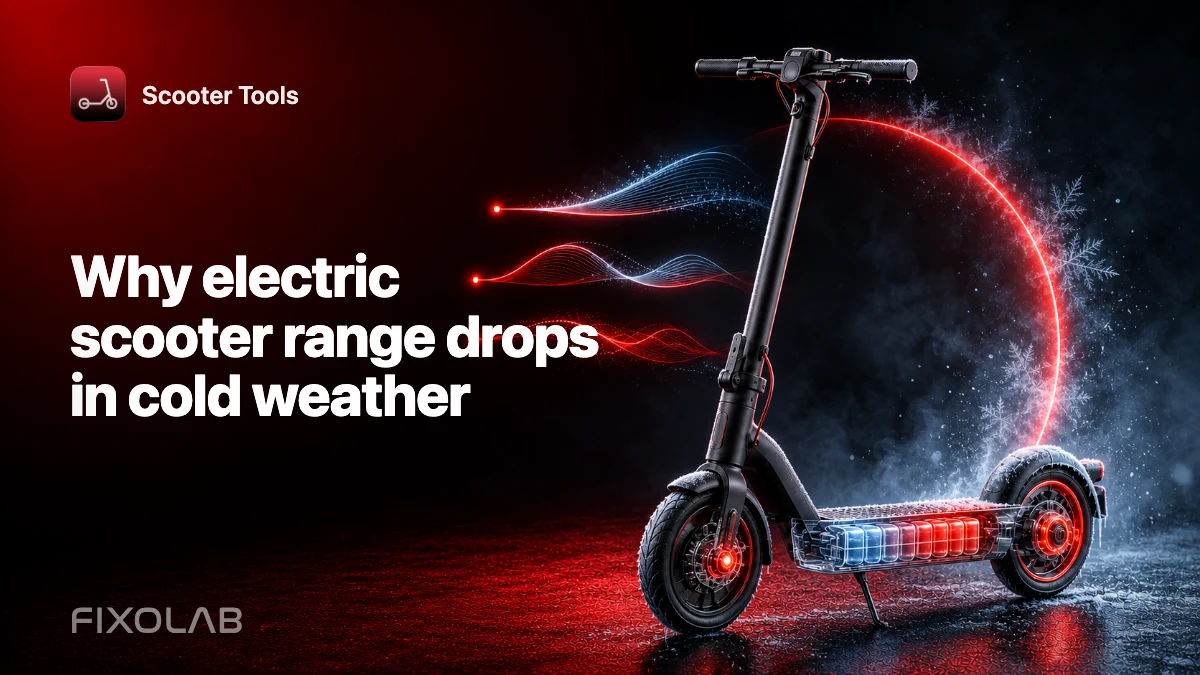
| FixoLab
Why electric scooter range drops in cold weather
Understand why cold weather reduces Xiaomi and Ninebot scooter range and how to interpret battery, temperature and trip data in Scooter Tools.