How to estimate real-world electric scooter range
The advertised range of an electric scooter comes from a defined test, not a promise for every rider and route. Speed, stops, gradients, temperature, wind, tire pressure, payload and battery age all change the distance available in practice.
A useful personal estimate comes from several representative rides with a safety reserve—not from multiplying one percentage point after a short downhill trip.
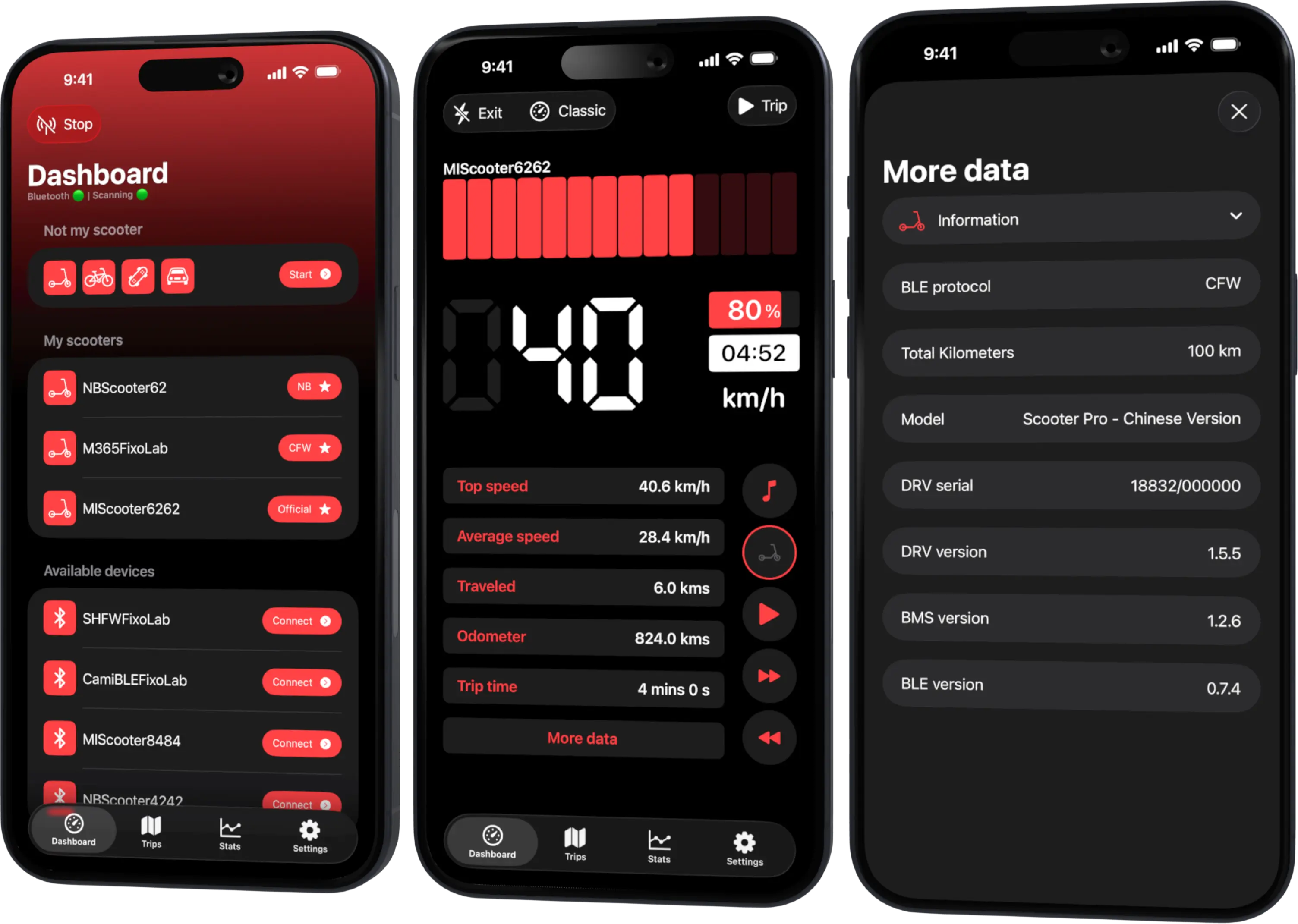
Your Xiaomi and Ninebot scooter dashboard
Monitor speed, battery, mileage, temperature and routes in real time, with support for official and custom firmware
Available on Android, iPhone, iPad and Mac, with Wear OS support and iCloud sync on Apple devices
Start with the manufacturer’s test
Read how the published range was measured. Look for rider mass, speed, mode, temperature, tire pressure and surface. If those conditions differ from your commute, expect a different result.
The number is still useful as a standardized comparison, but it should not be treated as a guaranteed destination distance.
Record a representative route
Choose a normal trip long enough to include realistic starts, hills and traffic. Before riding, note:
- battery percentage;
- riding mode;
- tire pressure from an external gauge;
- rider and cargo;
- weather and approximate wind;
- whether the battery is unusually hot or cold.
Record the ride in Scooter Tools where the model and platform support it. At the end, note distance and remaining percentage.
Calculate a cautious observation
If a 10 km ride used 35 percentage points, a simple linear projection would be about 28.6 km for 100 points. That is only a mathematical observation. Battery percentage is not perfectly linear, conditions can change, and the final part of the battery should not be planned as usable road range.
Instead, compare several similar trips and keep a meaningful reserve for detours, wind, cold and ageing.
Segment the route
A whole-trip average can hide the expensive part. Compare flat travel, sustained climbs, stop-start urban sections and exposed windy areas. The same 5 km can consume very different energy in each direction.
If a return journey climbs or faces prevailing wind, do not assume the outbound percentage will mirror it.
Understand the dashboard estimate
The scooter or app may estimate remaining range from current battery state and assumptions about consumption. Treat it as a moving estimate. It may change after acceleration, a hill, temperature change or a new riding mode.
Use percentage, route knowledge and a reserve together. Do not continue toward an isolated destination merely because one estimate remains optimistic.
Build seasonal profiles
Keep separate expectations for mild, hot and cold conditions. A route that leaves 35% in spring may leave much less in winter. Recheck after tire replacement, major service, firmware change or a noticeable battery trend.
Improve the estimate safely
- Use the correct tire pressure.
- Keep speed and acceleration consistent.
- Compare the same mode and payload.
- Avoid deliberate full depletion tests.
- Use complete trips rather than very short samples.
- Stop testing if the scooter shows a battery fault or physical warning sign.
Read charging habits that protect battery lifespan before turning range tests into repeated deep cycles.
Frequently asked questions
Can I multiply distance by 100 and divide by percentage used?
You can calculate that projection, but it is not a safe guaranteed range because percentage and conditions are not linear.
How much reserve should I keep?
There is no universal number. Choose a conservative reserve for the route, weather, battery condition and consequences of stopping.
Why is the return trip worse?
Gradient, wind, traffic and battery temperature may differ even on the same roads.
Does Scooter Tools promise the displayed range?
No. It presents available or derived telemetry; real-world range remains condition-dependent.
Your Xiaomi and Ninebot scooter dashboard
Monitor speed, battery, mileage, temperature and routes in real time, with support for official and custom firmware
Available on Android, iPhone, iPad and Mac, with Wear OS support and iCloud sync on Apple devices
| FixoLab
How hills and gradients affect electric scooter range
Understand why climbing increases scooter energy use, why descents do not recover it all and how to compare hilly routes with trip data.
| FixoLab
Reading Battery, Range, Temperature and Mileage in Scooter Tools
How Scooter Tools reads battery percentage, estimated range, temperature and mileage directly from your scooter's BMS over Bluetooth and shows them on your live dashboard.
| FixoLab
Eco, Drive and Sport modes on electric scooters explained
Compare electric scooter riding modes by acceleration, speed, range and traction, and use trip data to choose a mode for the route rather than the label.
| FixoLab
Why electric scooter range drops in cold weather
Understand why cold weather reduces Xiaomi and Ninebot scooter range and how to interpret battery, temperature and trip data in Scooter Tools.