Why electric scooter range drops in cold weather
Electric scooter range often falls as the weather gets colder. That does not automatically mean the battery has suddenly failed. Lower battery temperature, denser air, wind, wet roads, tire pressure and riding conditions can all change how far a Xiaomi or Ninebot scooter travels on the same displayed charge.
Scooter Tools helps you read the data your scooter reports, including battery percentage, estimated range, temperature and mileage where the model and firmware expose those fields. It does not perform an independent battery-health test, so the useful approach is to compare consistent rides and look for a pattern instead of judging the battery from a single cold morning.
Your Xiaomi and Ninebot scooter dashboard
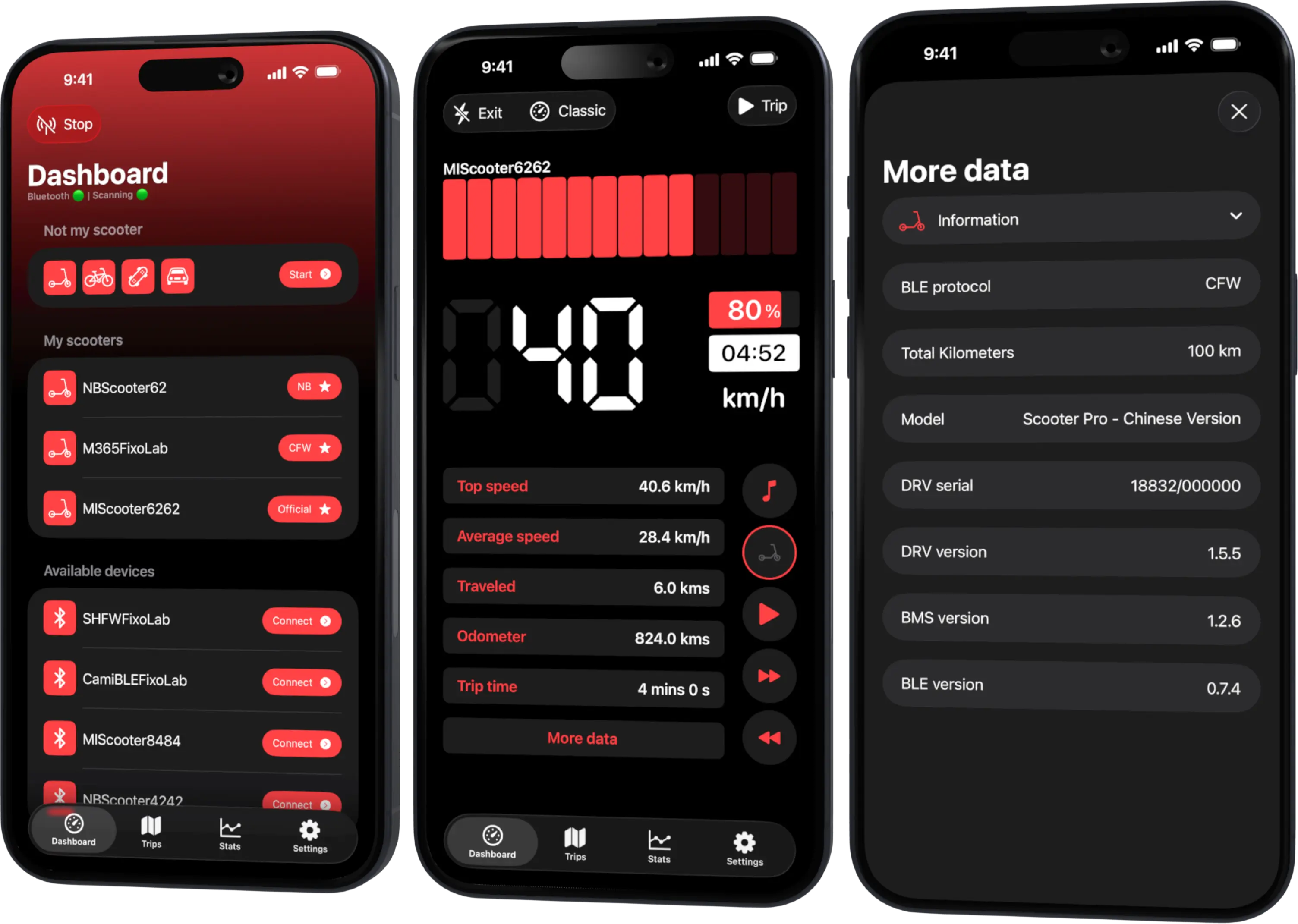
Monitor speed, battery, mileage, temperature and routes in real time, with support for official and custom firmware
Available on Android, iPhone, iPad and Mac, with Wear OS support and iCloud sync on Apple devices
Why cold weather reduces electric scooter range
Lithium-ion batteries do not deliver energy in exactly the same way at every temperature. In cold conditions, the chemical reactions inside the cells slow down and the battery has more internal resistance. The scooter’s battery-management system may reduce available power or charging behavior to protect the pack.
Xiaomi explains that low temperature can reduce battery activity, increase energy consumption and trigger low-temperature protection. Its current battery guidance also warns that performance and usable range fall below normal operating temperatures. Segway similarly lists ambient temperature as one of the factors that changes real-world range.
The effect you see on one ride is normally a combination of several conditions:
- Battery temperature: a pack that started the ride in a cold storage area may perform differently from one kept indoors.
- Tire pressure: pressure falls as temperature falls, increasing rolling resistance if it becomes too low.
- Wind and air density: a headwind requires more energy, especially at higher speeds.
- Wet or rough surfaces: rolling resistance and cautious acceleration can change the result.
- Rider and cargo weight: heavier total load requires more energy to accelerate and climb.
- Speed and acceleration: repeated strong acceleration and sustained high speed consume more energy.
- Hills: elevation changes can dominate a short comparison.
That is why the advertised maximum range should not be treated as a promise for every route and season.
What Scooter Tools can show you
After connecting a compatible scooter over Bluetooth, Scooter Tools can display the fields communicated by its controller and BMS.
Battery percentage
This is the current charge level reported by the scooter. It is more useful when compared at the same points on a repeated route than when viewed in isolation.
Estimated range
The number is a projection, not a guaranteed distance. Depending on the scooter and platform, the value can come from the scooter or from the app’s available telemetry. A cold battery, recent riding style and the firmware’s own calculation can all affect it.
Temperature
Compatible models may report battery or controller temperature. Check the label shown by your scooter and firmware rather than assuming every temperature field describes the same component.
Trip history
Scooter Tools can save distance, duration and speed for a ride when the connection remains active. Those records are useful for comparing what actually happened with the estimate visible before departure.
Read the existing guide to battery, range, temperature and mileage for a field-by-field explanation.
How to compare warm-weather and cold-weather rides
A useful comparison controls as many variables as practical:
- Choose a route you ride regularly.
- Start at a similar battery percentage.
- Check the tires against the pressure specified for your exact model.
- Keep riding mode, average speed and carried weight broadly similar.
- Record the outside conditions and whether the scooter was stored indoors or in the cold.
- Compare distance, duration and battery change in Scooter Tools after the ride.
One trip cannot isolate battery health. Several comparable rides can show whether the difference follows temperature and conditions or remains present in mild weather too.
Do not charge a battery that is too cold
Charging-temperature limits are safety limits, not performance tips. They differ between products and must come from the manual for your exact scooter and battery.
As an example, Segway instructs users of some batteries stored below 0 °C to move the scooter and battery to a warmer environment before charging. Xiaomi models can also block charging when the battery temperature is outside their permitted range.
If the scooter has been stored in freezing conditions, let it return to the temperature required by its manufacturer before connecting the charger. Do not heat the pack with a heater, hair dryer or other direct heat source.
A shorter range does not prove battery degradation
Battery degradation is a long-term loss of usable capacity. Cold-weather range loss can be temporary and may recover when the pack returns to normal temperature.
Scooter Tools displays the battery and ride information available from the scooter; it does not calculate an independent state-of-health percentage. Consider professional inspection if the range remains abnormally low across comparable mild-weather rides, the scooter reports battery errors, the pack becomes unusually hot, charging behaves incorrectly or the enclosure is damaged.
Practical autumn and winter checklist
- Check the manufacturer-recommended tire pressure regularly.
- Start important rides with more reserve than you would use in warm weather.
- Review the estimated range as guidance, not a guaranteed destination radius.
- Avoid storing or charging the scooter outside its documented temperature range.
- Keep the charging port dry and do not charge a wet scooter.
- Compare repeated trips before concluding that the battery has degraded.
- Read any error code or temperature warning shown by the scooter before continuing to ride.
Privacy of your ride data
Scooter Tools connects locally to the scooter over Bluetooth. Trip and route data is treated as sensitive and stays tied to your device and its platform-account synchronization; it is not uploaded to operate the scooter remotely.
The guide to recording trips and ride statistics explains what is stored and why keeping the Bluetooth connection active matters.
Frequently asked questions
Is it normal to lose range in winter?
Some reduction is normal because temperature and the other riding conditions described above affect battery output and energy use. The size of the change depends on the scooter, battery, route and weather.
Can Scooter Tools tell me the health percentage of my battery?
No. It shows the values reported by the scooter and BMS but does not run an independent capacity test or calculate a separate health score.
Why did the estimated range change after only a few minutes?
The estimate can react to current battery level, recent usage and the data available from the scooter. Acceleration, hills, wind and temperature can quickly change the projection.
Should I use one universal minimum temperature for every scooter?
No. Operating, storage and charging limits differ by model. Follow the manual and warnings for your exact Xiaomi, Ninebot or other scooter.
Your Xiaomi and Ninebot scooter dashboard
Monitor speed, battery, mileage, temperature and routes in real time, with support for official and custom firmware
Available on Android, iPhone, iPad and Mac, with Wear OS support and iCloud sync on Apple devices
| FixoLab
Reading Battery, Range, Temperature and Mileage in Scooter Tools
How Scooter Tools reads battery percentage, estimated range, temperature and mileage directly from your scooter's BMS over Bluetooth and shows them on your live dashboard.
| FixoLab
When to charge an electric scooter after a cold or wet ride
Decide when charging is safe after rain, cold or a hard ride by checking moisture, battery temperature, connectors and manufacturer limits.
| FixoLab
Eco, Drive and Sport modes on electric scooters explained
Compare electric scooter riding modes by acceleration, speed, range and traction, and use trip data to choose a mode for the route rather than the label.
| FixoLab
What to watch in electric scooter motor and battery temperature
Interpret available scooter temperature data in context, recognize thermal warning signs and avoid using one sensor value as a complete diagnosis.