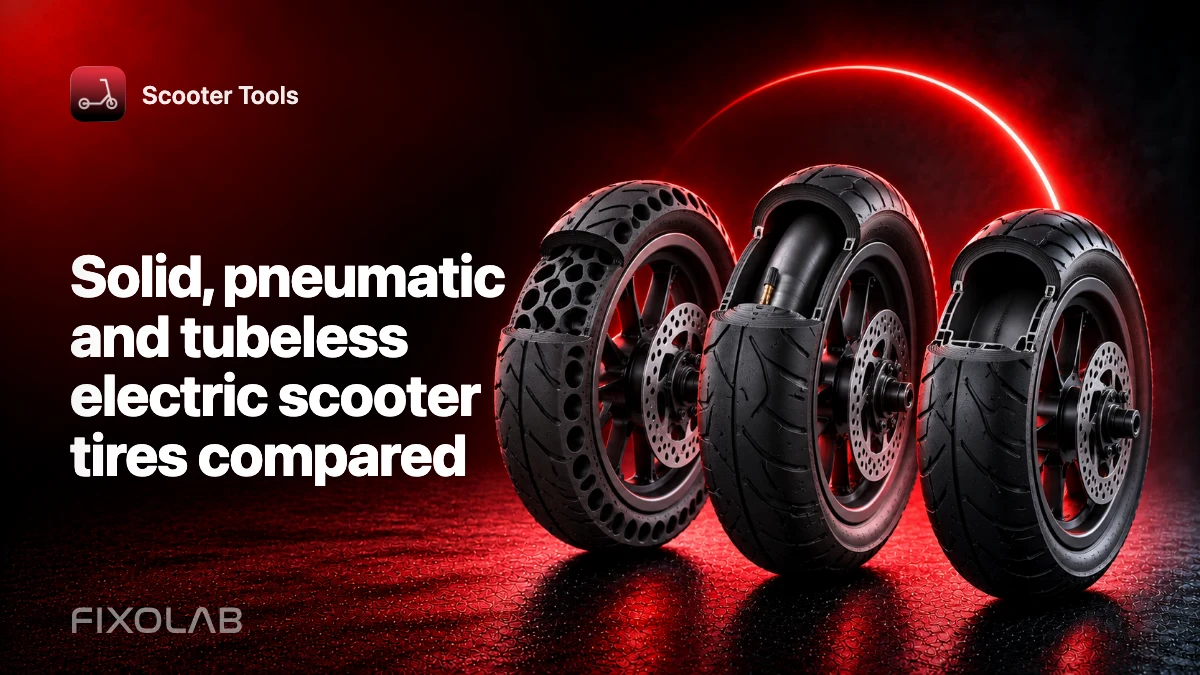
Solid, pneumatic and tubeless electric scooter tires compared
Tire construction changes comfort, grip, maintenance and how impacts reach the scooter. Solid tires avoid loss of air, while pneumatic tires use air to absorb irregularities and usually provide a different contact feel. Tubeless designs remove the inner tube but still require pressure and an airtight tire-rim system.
Choose only a type, size and load rating approved for the exact scooter. A conversion that fits physically can still change braking, clearance, motor cooling or structural loads.
Your Xiaomi and Ninebot scooter dashboard
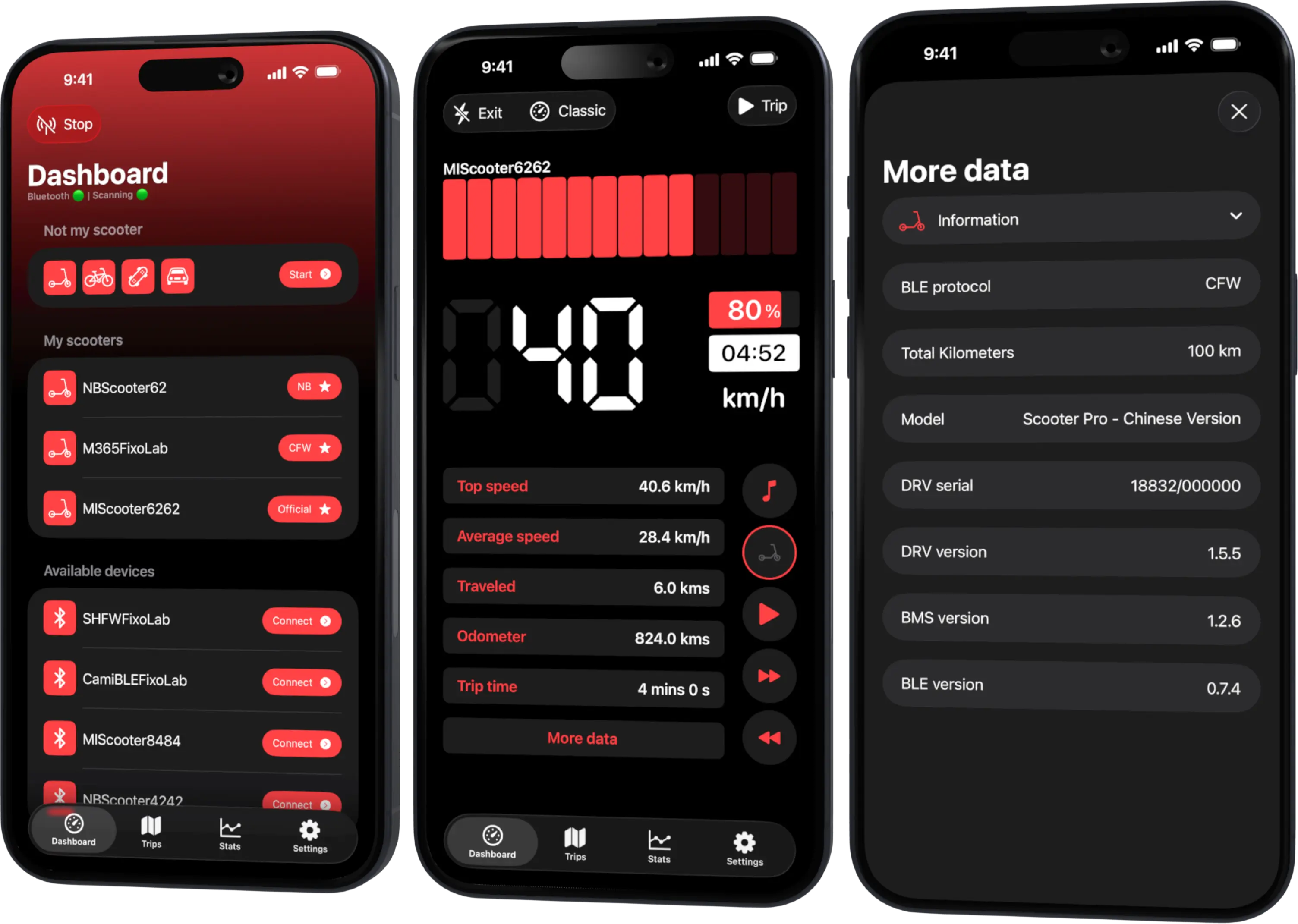
Monitor speed, battery, mileage, temperature and routes in real time, with support for official and custom firmware
Available on Android, iPhone, iPad and Mac, with Wear OS support and iCloud sync on Apple devices
Tubed pneumatic tires
An inner tube holds the air inside the tire. The air volume helps absorb bumps and can offer good grip and comfort at the specified pressure.
The tube can be pinched by an impact when pressure is too low, and punctures require removal and repair or replacement. Valve alignment and correct installation matter; a trapped or twisted tube can fail early.
Tubeless pneumatic tires
The tire and rim form the air chamber without a conventional inner tube. Some punctures may lose air more slowly, and approved sealant may work on certain small tread punctures.
Tubeless does not mean maintenance-free. The bead, rim and valve must seal, pressure must still be checked, and sidewall or bead damage requires proper repair. Use only sealant and procedures permitted by the manufacturer.
Solid tires
Solid or honeycomb tires cannot suffer an ordinary air puncture. That can reduce pressure maintenance, but it usually brings a firmer ride and can transmit more vibration to the rider and scooter.
Grip, especially on wet or rough surfaces, depends on compound and tread. A solid conversion may also affect fit, wheel service and ride behavior. Do not treat puncture resistance as proof of equal safety.
How tires affect range data
Low pressure increases deformation and rolling resistance. A correctly specified pneumatic tire can therefore use less energy than the same tire underinflated. A solid tire changes the comparison because construction, compound and deformation differ.
When using Scooter Tools to compare battery use, record the tire type, pressure where applicable, route, weather and payload. Comparing a new solid tire to an old underinflated pneumatic tire does not isolate construction alone.
Grip and braking
The tire is the final connection for acceleration, steering and braking. Inspect tread, cuts, embedded debris, flat spots and ageing. A tire that never punctures can still wear out or lose grip.
After any tire replacement, test steering and braking at low speed in a safe area. Stop if the tire rubs, the wheel is not seated correctly or braking feels different.
Maintenance checklist
Pneumatic
- Check cold pressure with a gauge.
- Inspect the valve and repeated pressure loss.
- Use the model-specific pressure range.
- Repair punctures with an approved method.
Solid
- Inspect tread, cracks, deformation and fit.
- Check wheel fasteners and unusual vibration.
- Replace when wear reaches the manufacturer’s limit.
Tubeless
- Check pressure, bead, valve and rim condition.
- Follow approved sealant intervals if applicable.
- Do not ride a damaged sidewall.
For pressure-specific guidance, read how tire pressure affects range and handling.
Frequently asked questions
Are solid tires always safer?
They eliminate ordinary air punctures but can change grip, comfort and loads. Safety depends on approved fit and condition.
Are tubeless tires puncture-proof?
No. They can be punctured, lose a bead seal or suffer sidewall damage.
Can Scooter Tools tell which tire is fitted?
No. Tire type and pressure require physical identification and inspection.
Will changing tire type change range?
It can, but route, pressure, compound, size and riding conditions also influence the result.
Your Xiaomi and Ninebot scooter dashboard
Monitor speed, battery, mileage, temperature and routes in real time, with support for official and custom firmware
Available on Android, iPhone, iPad and Mac, with Wear OS support and iCloud sync on Apple devices
| FixoLab
How tire pressure affects electric scooter range and handling
Learn how tire pressure changes scooter range, handling and comfort, how to use the correct model-specific value and what Scooter Tools can compare.
| FixoLab
How rider weight and payload affect electric scooter range
Understand how total mass changes acceleration, hills, braking, tire load and real-world range without treating the scooter's maximum payload as a target.
| FixoLab
Reading Battery, Range, Temperature and Mileage in Scooter Tools
How Scooter Tools reads battery percentage, estimated range, temperature and mileage directly from your scooter's BMS over Bluetooth and shows them on your live dashboard.
| FixoLab
How to clean an electric scooter without causing water damage
Clean an electric scooter safely around its battery, motor, display and charging port while avoiding pressure washing and unsafe chemicals.