Why scooter battery percentage rises after stopping
A scooter can show a higher percentage after it rests even though no energy was added. The main reasons are voltage recovery after load and the battery model updating its estimate.
Scooter Tools can show supported local Bluetooth telemetry and trip context. It does not flash firmware, bypass ownership, certify a repair or replace the scooter manufacturer’s safety instructions.

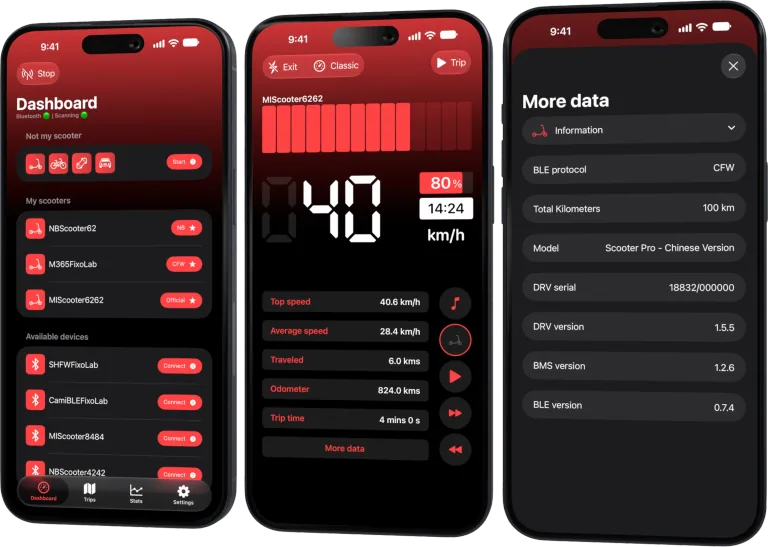
Your Xiaomi and Ninebot scooter dashboard
Monitor speed, battery, mileage, temperature and routes in real time, with support for official and custom firmware
Available on Android, iPhone, iPad and Mac, with iCloud sync on Apple devices
Voltage rebounds after load
During acceleration or climbing, current causes temporary voltage sag. When the load ends, voltage rises toward its resting value and the estimated percentage can follow.
Temperature can change the estimate
A cold battery may warm during riding and make more of its stored energy available. The reverse can happen when a warm pack cools.
Display smoothing creates steps
Some scooters update battery bars slowly or in rounded increments. Two applications may poll at different times and display a different but nearby value.
Use a consistent resting checkpoint
For range tracking, record the value after the same short rest at the start and end of a route. Do not treat rebound as newly charged energy.
Safe review checklist
- Note load and temperature.
- Wait the same rest interval.
- Compare percentage with voltage.
- Track the pattern across several rides.
Frequently asked questions
Did regenerative braking add the recovered percentage?
It may add a small amount, but a post-stop jump is often mostly estimation and voltage recovery.
Is rebound dangerous?
Small repeatable recovery is normal; large erratic changes or shutdowns deserve service.
Which value should I use for planning?
Use conservative range history and keep a reserve rather than relying on one percentage.
Your Xiaomi and Ninebot scooter dashboard
Monitor speed, battery, mileage, temperature and routes in real time, with support for official and custom firmware
Available on Android, iPhone, iPad and Mac, with iCloud sync on Apple devices
| FixoLab
Why an electric scooter battery drains while switched off
Check storage duration, standby electronics, temperature and battery condition when charge falls while the scooter is off.
| FixoLab
Autumn and winter electric scooter maintenance checklist
Prepare tires, brakes, battery, lights, seals and storage for colder, wetter scooter riding while using trip data to reset range expectations.
| FixoLab
When to charge an electric scooter after a cold or wet ride
Decide when charging is safe after rain, cold or a hard ride by checking moisture, battery temperature, connectors and manufacturer limits.
| FixoLab
Electric scooter battery health warning signs and useful data
Separate normal range variation from possible electric scooter battery trouble using repeatable rides, available telemetry and physical warning signs.