Electric scooter battery health warning signs and useful data
Battery health is not one number on the dashboard. Capacity, internal resistance, temperature, cell balance and the battery-management system all affect behavior, while wind, pressure, payload and hills change the range you see on any single ride.
Scooter Tools can help organize observations from compatible telemetry. It cannot open the pack, measure every cell or certify a damaged battery as safe.
Your Xiaomi and Ninebot scooter dashboard
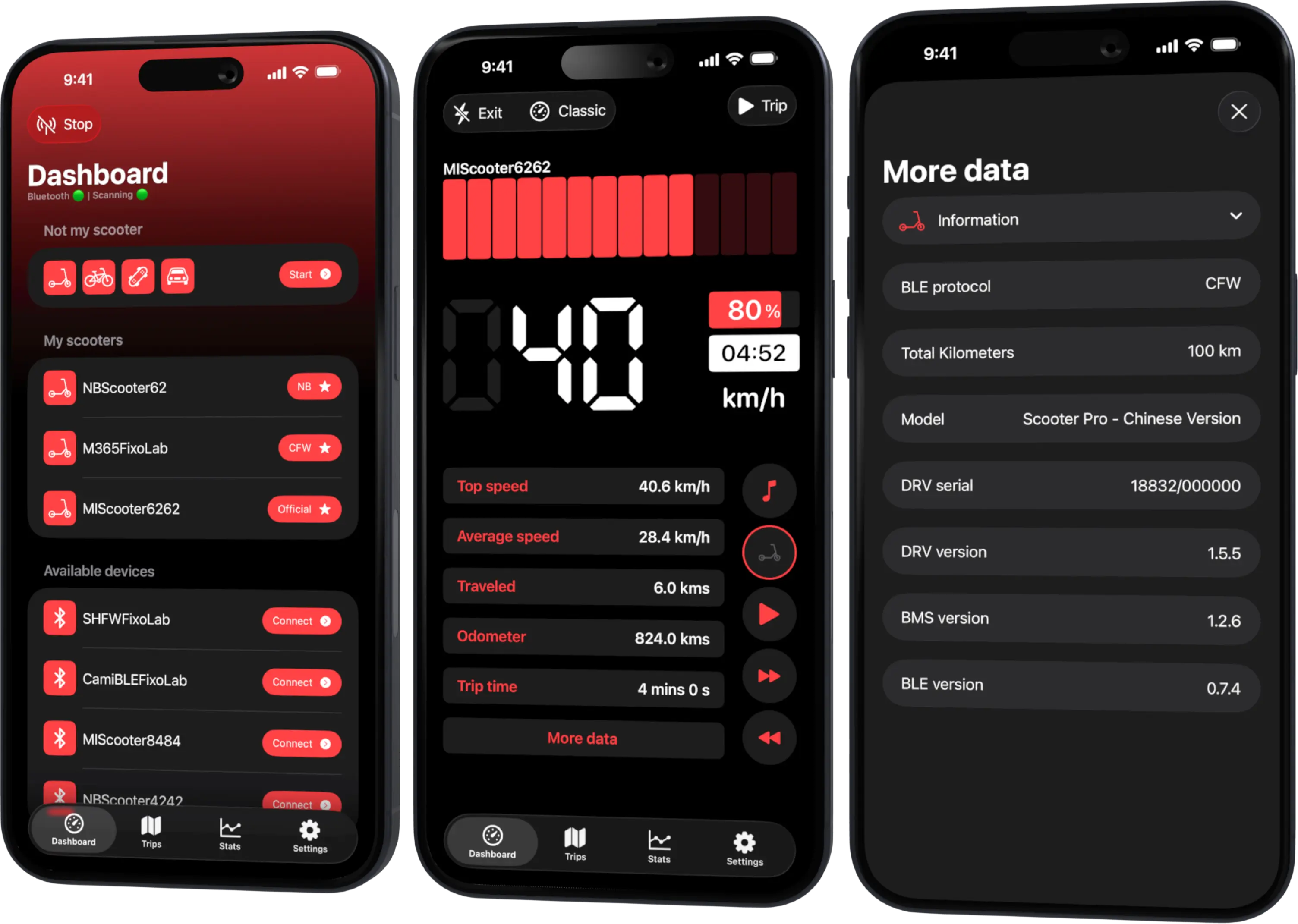
Monitor speed, battery, mileage, temperature and routes in real time, with support for official and custom firmware
Available on Android, iPhone, iPad and Mac, with Wear OS support and iCloud sync on Apple devices
Start with normal variation
A lower estimated range can be normal after a temperature drop, a faster route, more climbing, low tire pressure or heavier cargo. Even the displayed percentage can move non-linearly because it is an estimate based on voltage, current and the scooter’s own logic.
Compare several rides before deciding that capacity has changed.
Build a repeatable comparison
Choose a familiar route and record:
- starting and ending battery percentage;
- distance and duration;
- average speed and riding mode;
- approximate temperature and wind;
- tire pressure measured externally;
- rider and cargo load;
- long stops or steep climbs.
Repeat under reasonably similar conditions. A consistent trend matters more than one unusual day.
Telemetry that may help
Depending on model and platform, a compatible scooter may expose battery percentage, voltage, current, temperature, estimated range and mileage. Read these together.
For example, a range estimate may fall simply because recent consumption increased. A temperature spike during a hard climb may be temporary, while repeated abnormal temperature on an easy route needs investigation.
Do not compare raw thresholds copied from another model. Battery layouts and firmware limits differ.
Warning signs that need action
Stop using or charging the scooter and seek qualified guidance when there is:
- swelling, deformation or a lifted deck cover;
- smoke, hissing, leaking material or chemical smell;
- severe or localized heat;
- water intrusion or impact near the battery;
- repeated shutdown under modest load;
- a charger or connector that overheats or arcs;
- a manufacturer battery fault that returns after the documented reset.
If there is an immediate fire risk, move away and contact emergency services. Do not handle a smoking or burning lithium battery without the training and equipment required locally.
Sudden percentage drops
A sharp fall under acceleration can reflect voltage sag, cold temperature, ageing or an estimation problem. Note when it happens, the starting charge, temperature and load. If the scooter shuts down or the symptom is repeatable, stop testing it on public roads and obtain service.
Range loss versus safety fault
Gradual capacity loss usually appears as a repeatable reduction in usable energy. A safety fault can produce heat, smell, swelling, error states or abrupt shutdown. Do not continue riding merely to collect more data when a physical warning sign exists.
Keep a useful record
Store dates and summarized observations, not sensitive BLE material or exact private routes. A service technician benefits from a concise timeline: model, age, mileage, conditions, charger used and repeatable symptom.
For a closer look at the dashboard values, see reading battery, range, temperature and mileage.
Frequently asked questions
Can an app calculate battery health exactly?
Not from ordinary dashboard telemetry alone. A reliable diagnosis may require manufacturer tools and physical testing.
Is a lower winter range permanent?
Not necessarily. Cold temporarily reduces usable performance; compare again in moderate conditions.
Should I deliberately drain the battery to calibrate it?
Do not perform a deep discharge unless the exact manufacturer procedure asks for it. Repeated extremes can add wear.
What should I send to support?
Model, app version, approximate conditions, redacted error and a short repeatable timeline—never pairing secrets, exact routes or raw identifiers.
Your Xiaomi and Ninebot scooter dashboard
Monitor speed, battery, mileage, temperature and routes in real time, with support for official and custom firmware
Available on Android, iPhone, iPad and Mac, with Wear OS support and iCloud sync on Apple devices
| FixoLab
Reading Battery, Range, Temperature and Mileage in Scooter Tools
How Scooter Tools reads battery percentage, estimated range, temperature and mileage directly from your scooter's BMS over Bluetooth and shows them on your live dashboard.
| FixoLab
Eco, Drive and Sport modes on electric scooters explained
Compare electric scooter riding modes by acceleration, speed, range and traction, and use trip data to choose a mode for the route rather than the label.
| FixoLab
Electric scooter IP ratings and water resistance explained
Learn what an electric scooter IP code does and does not mean, how ageing affects water resistance and how to inspect a scooter after wet exposure.
| FixoLab
What to watch in electric scooter motor and battery temperature
Interpret available scooter temperature data in context, recognize thermal warning signs and avoid using one sensor value as a complete diagnosis.