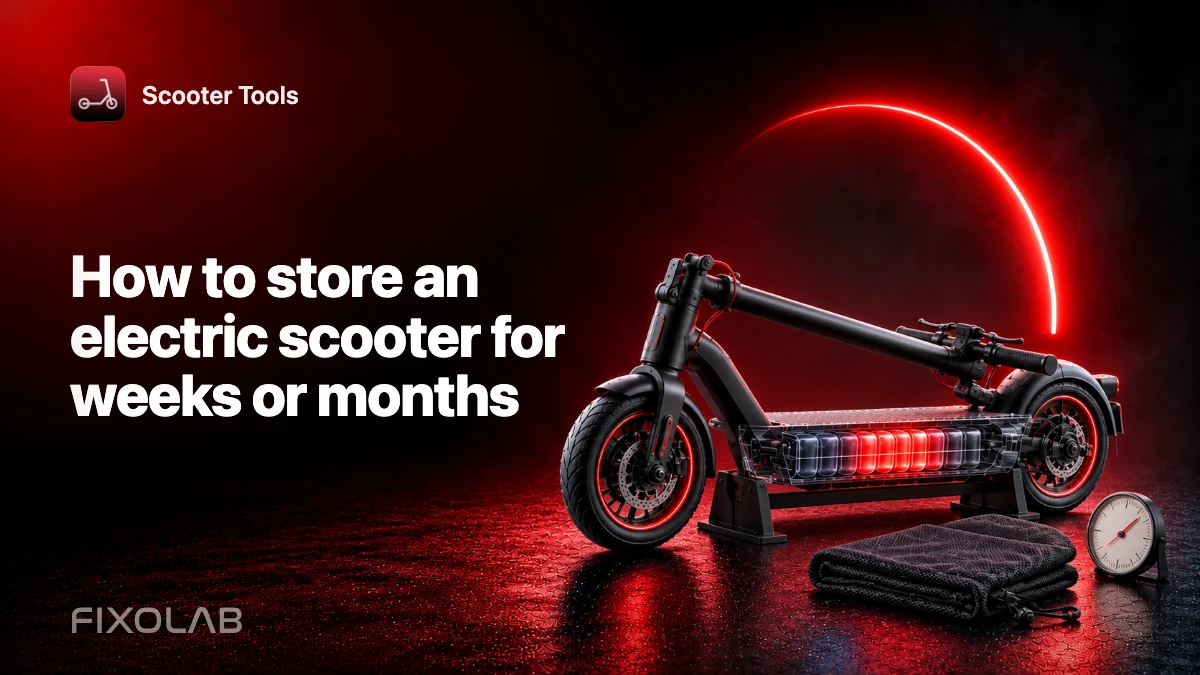
How to store an electric scooter for weeks or months
Long-term storage is not simply parking the scooter and forgetting it. A battery can self-discharge, pneumatic tires lose pressure, moisture causes corrosion and a poor location can expose the vehicle to heat, freezing or theft.
The exact manual determines the storage charge, temperature and inspection interval. Use those values rather than a generic percentage copied from another battery.
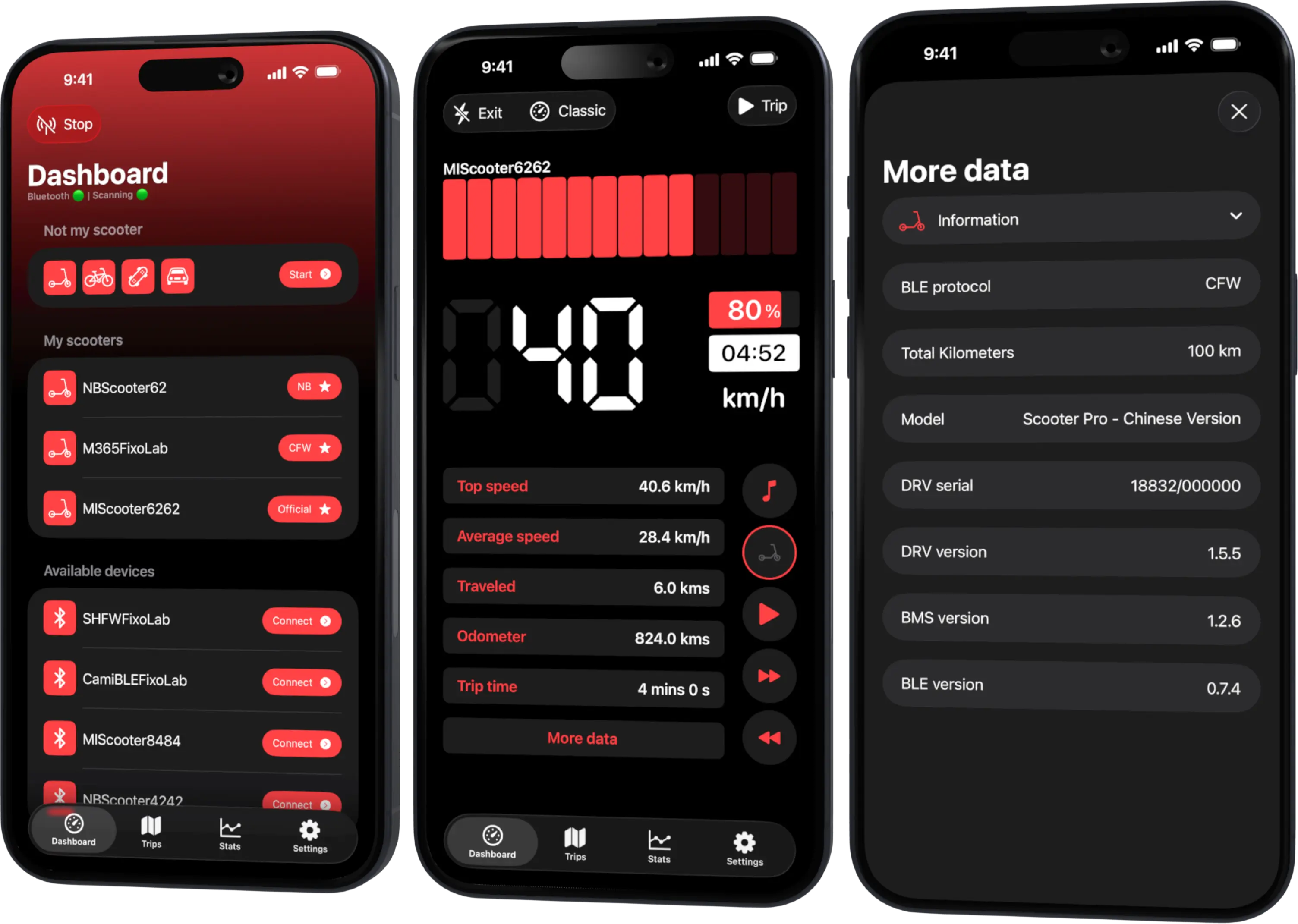
Your Xiaomi and Ninebot scooter dashboard
Monitor speed, battery, mileage, temperature and routes in real time, with support for official and custom firmware
Available on Android, iPhone, iPad and Mac, with Wear OS support and iCloud sync on Apple devices
Choose the location
Store the scooter in a dry, ventilated place within the manufacturer’s temperature limits. Keep it away from direct sun, heaters, freezing conditions, standing water and combustible escape routes.
Do not leave it connected to a charger unless the manufacturer explicitly specifies a supported maintenance mode. Protect it from children, pets and accidental activation.
Prepare the battery
Finish with the storage state of charge specified for the model. Avoid leaving a depleted pack for weeks, and do not assume a permanently full battery in heat is ideal.
Switch the scooter off fully. If the manual requires periodic checks, create a calendar reminder and use the approved charger when the level reaches the documented threshold. A battery that will not charge, swells, smells or heats abnormally needs qualified service.
Prepare tires and brakes
Inflate pneumatic tires to the storage guidance and check them periodically. Long periods on an underinflated tire can deform it. If the manufacturer recommends lifting or rotating the wheels, follow that procedure with a stable approved support.
Keep brake surfaces clean and dry. Do not apply oil to prevent rust where it can contaminate pads or drums.
Clean and inspect first
Remove road salt, mud and organic material using the approved low-moisture method. Let the scooter dry completely. Record existing damage so that you can tell whether a crack, leak or deformation changed during storage.
Check the folding latch, charging-port cover, cables and fasteners. Store accessories and the charger where their cables cannot be crushed.
Security and privacy
Lock the scooter according to the location and keep proof of ownership and serial information securely. Do not publish serial numbers or pairing credentials.
If another person can access the stored device, consider what trip history or dashboard information remains visible on paired phones, widgets or watches.
Periodic storage check
At the model’s documented interval:
- inspect for moisture, pests and physical damage;
- check tire condition and pressure;
- observe battery state without unnecessary riding;
- recharge only as instructed;
- verify the charger and port remain undamaged.
Do not wake and deeply cycle the battery merely to “exercise” it.
Return to service
Before the first ride, inspect tires, brakes, folding mechanism, lights, cables and battery enclosure. Charge according to the normal procedure, connect Scooter Tools if compatible and check the available telemetry and error state.
Perform the first test at low speed in a safe area. A successful Bluetooth connection does not certify the mechanical condition.
Frequently asked questions
What percentage should I store it at?
Use the exact model’s manual. There is no single correct target for every scooter and storage duration.
Should I leave the charger plugged in?
Only if the manufacturer explicitly supports that storage method. Otherwise disconnect it.
Can Scooter Tools maintain the battery during storage?
No. The app may display available state when connected, but storage management belongs to the scooter and owner.
Do solid tires remove all storage checks?
No. They avoid air loss but still need inspection for cracks, deformation and flat spots.
Your Xiaomi and Ninebot scooter dashboard
Monitor speed, battery, mileage, temperature and routes in real time, with support for official and custom firmware
Available on Android, iPhone, iPad and Mac, with Wear OS support and iCloud sync on Apple devices
| FixoLab
Electric scooter charging habits that protect battery lifespan
Build a safer charging routine for an electric scooter battery, avoid heat and deep discharge, and separate everyday range from long-term battery health.
| FixoLab
Reading Battery, Range, Temperature and Mileage in Scooter Tools
How Scooter Tools reads battery percentage, estimated range, temperature and mileage directly from your scooter's BMS over Bluetooth and shows them on your live dashboard.
| FixoLab
Eco, Drive and Sport modes on electric scooters explained
Compare electric scooter riding modes by acceleration, speed, range and traction, and use trip data to choose a mode for the route rather than the label.
| FixoLab
What to watch in electric scooter motor and battery temperature
Interpret available scooter temperature data in context, recognize thermal warning signs and avoid using one sensor value as a complete diagnosis.